Blueberries & Eye Health

Are Blueberries Good for Your Eyes? The Inflammation Connection That Changes the Conversation

After 14 years and over 24,000 patients, a Harvard-trained ophthalmologist identified a surprising connection between wild blueberry compounds, chronic inflammation, and progressive vision loss — and a natural morning protocol built around it.

Key Takeaways at a Glance

The natural blueberry-based eye health protocol — watch the free presentation

The blueberry-based eye health protocol — watch the free presentation

The Quiet Moment When Vision Loss Becomes Real

There's a moment most people with vision problems know well. You're at a dinner table, looking across at someone you love — a grandchild, a partner, a close friend — and you realize you can't actually see their face. Not clearly. You smile and nod and say the right things, but something inside you tightens, because what you're really thinking is: how much worse is this going to get?

You've probably done everything right. You went to the doctors. You got the diagnoses — macular degeneration, glaucoma, diabetic retinopathy, cataracts. You followed the prescriptions, scheduled the appointments, endured the injections. And yet, month after month, the vision keeps changing. The world keeps getting a little smaller, a little dimmer, a little harder to navigate on your own terms.

If that's where you are — if you've been quietly carrying the weight of wondering whether independence, reading, driving, and truly seeing the faces of the people you love are things that belong to your past — there is something genuinely new that may deserve your attention. And it involves something surprisingly simple: a compound found in the deep-blue skin of wild blueberries — one that researchers at institutions like Johns Hopkins and Harvard have been quietly studying for its effect on eye tissue.

"Most of our treatments for conditions like macular degeneration or glaucoma really rely upon slowing progression and treating symptoms. We didn't have any real mechanism to repair or restore vision. This new avenue opens up ways to actually do that."

— Board-certified ophthalmologist, speaking on clinical research findings

A growing body of research — including work from teams at Harvard Medical School, the National Eye Institute, and Johns Hopkins' Wilmer Eye Institute — is pointing to something that fundamentally changes how we understand vision loss. And it has nothing to do with how old you are.

The Inflammation Connection Your Eye Doctor May Not Have Mentioned

For decades, the prevailing explanation for age-related vision loss has been straightforward: aging, genetics, diabetes, high blood pressure. These are real factors. But a growing number of researchers now believe they explain the conditions that damage your eyes — not the underlying biological process that allows that damage to spread unchecked.

What they've identified is something called chronic low-grade inflammation — a persistent state of cellular stress that progressively disrupts the delicate blood vessels, nerves, and tissue that keep your eyes functioning. Under normal circumstances, your body maintains a natural repair system: specialized stem cells that travel through your bloodstream and quietly rebuild damaged eye tissue every day, without you ever noticing.

But when chronic inflammation takes hold — triggered by decades of oxidative stress, environmental exposure, and the kind of cellular wear that accumulates silently over a lifetime — that repair system starts breaking down. Stem cells that should be restoring your eyes begin dying faster than they can do their job. And what starts as needing a bit more light to read gradually becomes something no prescription lens can compensate for.

What makes this research significant is that most standard treatments work at the level of symptoms — managing pressure, suppressing leaking vessels, correcting refraction. The emerging question researchers are exploring is whether addressing the underlying inflammatory process directly may produce results that work differently from what conventional treatment alone achieves.

Signs That Chronic Inflammation May Be Affecting Your Vision

  • You wear glasses or contacts — and still struggle to see clearly in certain conditions
  • When you look up from reading, the world stays slightly blurry for several seconds before it refocuses
  • Colors seem less vivid or the world looks hazier than it used to, even with corrective lenses
  • You need significantly more light to read comfortably, or headlights at night seem unusually glaring
  • You notice floaters, specks, or shadows drifting across your field of vision
  • Your peripheral vision feels narrower — like the edges of your visual field are gradually closing in
  • Your eyes feel chronically dry, irritated, or fatigued — even with lubricating drops

Researchers note that when left unaddressed, the same inflammatory pathways that affect the eyes don't stay localized. A large-scale analysis of 14 independent studies — covering over 6.2 million older adults — found a significant statistical association between vision impairment and elevated dementia risk. The connection appears to run through shared inflammatory and vascular pathways, suggesting that what happens in the eyes may reflect what's happening in the brain.

47% Higher statistical risk of dementia observed in adults with vision impairment, per analysis of 14 studies covering 6.2 million participants. Source: peer-reviewed research, published medical literature.
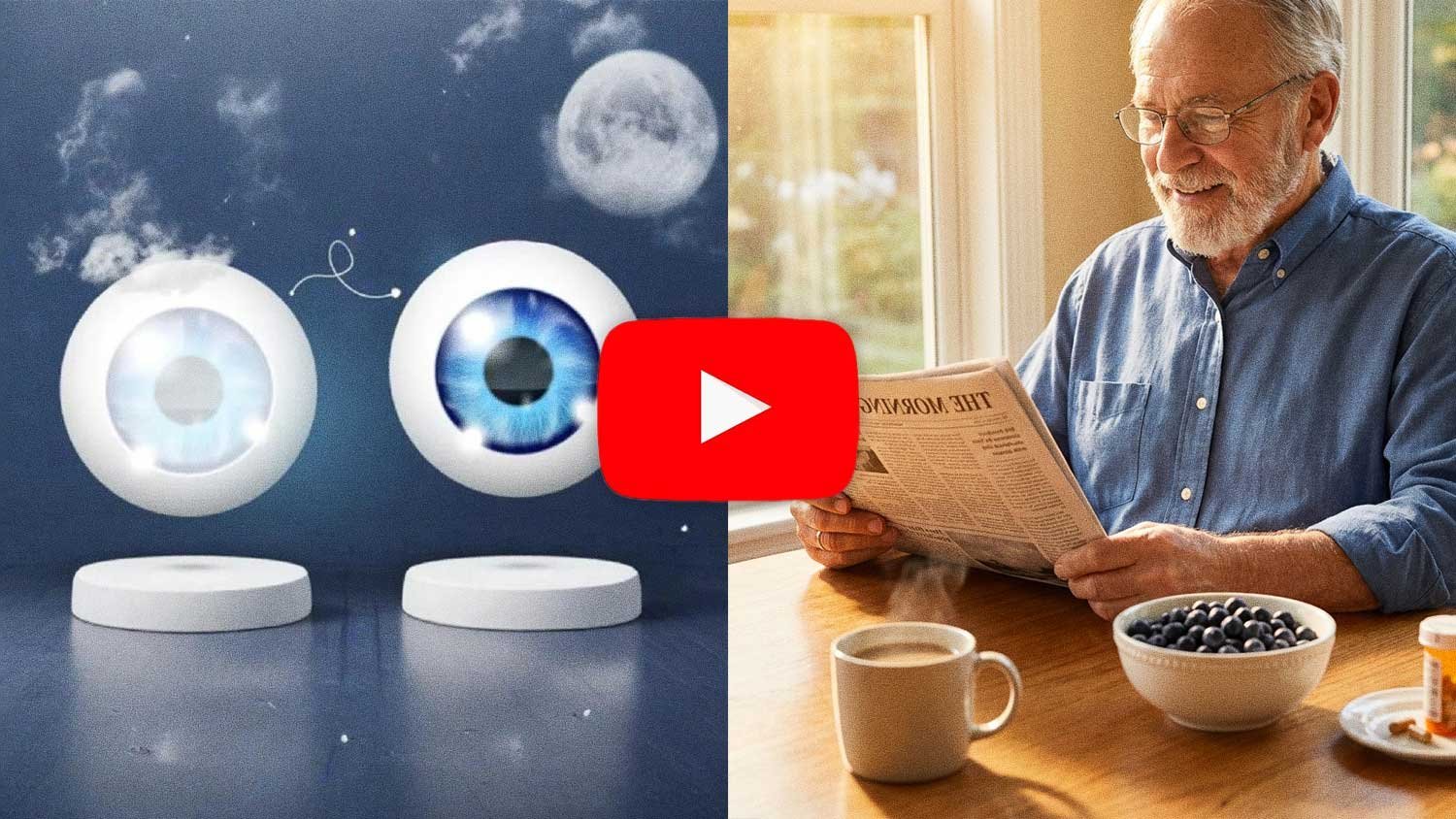
A Natural Protocol Targeting Inflammation — What the Clinical Research Shows

Dr. Ming Wang has spent 14 years as a Harvard-trained ophthalmologist — treating patients ranging from early-stage macular degeneration to advanced vision loss — and became known in his field for pursuing natural, non-surgical approaches that worked where conventional treatments fell short.

Several years ago, what began as a personal search — prompted by watching a family member's vision deteriorate despite standard treatment — led him to examine an entirely different angle: what if the goal wasn't to manage the damage, but to reactivate the body's own capacity to repair it?

That question drove five years of research in collaboration with Harvard colleagues, eventually leading to a specific combination of three natural compounds — each backed by independent clinical studies — that appeared to work synergistically to reduce ocular inflammation, protect against further cellular damage, and support the body's natural eye-repair mechanisms.

The results across more than 550 study participants — and subsequently, across over 24,000 patients in Dr. Wang's clinical practice — were significant enough that his team began referring to the phenomenon as the "Eye Rebirth Effect": measurable improvements in visual clarity, contrast sensitivity, and night vision in patients whose conditions had previously only been managed with standard treatment.

The Three-Compound Protocol

Wild Nordic Blueberry Extract (anthocyanins): Widely regarded as one of the best berries for eye health, wild blueberries are rich in anthocyanins. Research from the Wilmer Eye Institute at Johns Hopkins and independent European studies has identified anthocyanin-rich berry extracts as potent anti-inflammatory agents with specific affinity for ocular tissue — helping to reduce the chronic inflammation that disrupts stem cell activity in the eyes.

Lutein and Zeaxanthin Complex: A five-year study by the National Eye Institute — involving over 4,000 participants aged 58 to 86 — found that individuals with the highest levels of these carotenoids had significantly lower rates of advanced macular degeneration, cataracts, and glaucoma. These compounds accumulate directly in the macula and act as a natural filter against oxidative and blue-light damage.

Astaxanthin: A Mayo Clinic clinical study involving 254 participants found that daily astaxanthin supplementation produced measurable improvements in visual acuity, contrast sensitivity, and eye fatigue — with advanced scans suggesting cellular activity comparable to eyes functioning 8 to 10 years younger. Astaxanthin supports mitochondrial function inside eye cells, directly fueling the repair and regeneration process.

🫐
Wild Nordic Blueberry Extract
Reduces inflammation, supports stem cell reactivation in ocular tissue
🌼
Lutein & Zeaxanthin
Shields the macula, reduces oxidative and blue-light stress
🐡
Astaxanthin
Fuels mitochondria in eye cells — accelerates natural repair
About the Researcher
Dr. Ming Wang, M.D., Ph.D.
Harvard Medical School — Ophthalmology  |  Author, "From Darkness to Sight"  |  14 Years Clinical Research

Dr. Wang has spent over a decade researching natural approaches to vision health — pursuing what conventional ophthalmology has not traditionally investigated: whether addressing the inflammatory process directly, alongside standard care, may produce measurably different outcomes. His research, conducted alongside colleagues at Harvard and peer institutions, has been documented across more than 24,000 patient cases.

"The goal was never to give people a better way to cope with losing their vision. It was to find a way to give it back. Once we understood that inflammation was shutting down the repair system — not aging itself — everything changed."

What People Are Saying

My eyes feel clearer than they have in years. The floaters I'd been dealing with for two years are noticeably reduced. Night driving, which I'd given up entirely, doesn't feel dangerous anymore.
— Daniel R., 68, Florida
I'd stopped knitting after my retinal condition worsened — I couldn't see the stitches. Three weeks into this protocol, I picked it back up. I'm making a blanket for my great-granddaughter.
— Margaret T., 74, Ohio
I went back to my ophthalmologist after six weeks. He reviewed my scans and said my results were "better than expected." I hadn't told him what I'd been doing. He asked.
— Joseph H., 71, Texas
After months of injections that helped temporarily but never really solved anything, doing something this simple that actually seems to be working — it's hard to put into words how that feels.
— Sarah M., 66, Georgia

The complete protocol — including the specific blueberry-based compounds, concentrations, and the simple morning routine developed from this research — is now being shared publicly in a free educational presentation. In it, he walks through the science behind chronic ocular inflammation, the clinical evidence for each ingredient, and exactly what his patients have been doing that produced results worth understanding.

If you've been living with progressive vision loss and are looking for a research-based perspective that goes beyond standard management, this free presentation covers the full picture.

Watch the Full Eye Health Presentation

The complete natural vision protocol — the blueberry-based compounds, the clinical evidence, and the simple daily routine — explained in full, at no charge.

Watch the Free Presentation →

Free to watch · No sign-up required to begin

Frequently Asked Questions

Are blueberries actually good for your eyes?
Yes — and not in the vague "eat-your-vegetables" way. Wild blueberries are dense with anthocyanins, a specific class of antioxidant that researchers have studied for decades in connection with ocular tissue. They are widely regarded as one of the best berries for eye health.
Which berry is best for eye health?
Wild blueberries and bilberries lead most rankings due to their anthocyanin density and the volume of eye-specific research behind them. Blackcurrants are a strong secondary option. Goji berries contribute zeaxanthin through a different mechanism.
Can blueberries help with peripheral vision?
Blueberries are not a treatment for peripheral vision loss. However, the antioxidant compounds they contain support the vascular and neural tissue of the entire retina — including the areas that serve peripheral vision. Any change in side vision should be evaluated by an eye care professional.
What is chronic ocular inflammation?
It's a persistent, low-level inflammatory state in the eye tissue that can disrupt the body's natural repair mechanisms over time. Emerging research suggests it may play a larger role in age-related vision changes than previously understood.
Is this presentation free?
Yes. The presentation is free to watch and no sign-up is required to begin viewing.
Should I still see my eye doctor?
Absolutely. Nothing in this presentation replaces professional medical care. Regular comprehensive eye exams remain the most reliable way to monitor and protect your vision.